Zarathustra
Thus Spoke ZarathustraZarathustra is a teacher who leaves a decade of mountain solitude to return to humanity, only to discover that teaching requires both companions capable of following themselves and the strength to endure what his message awakens. His path repeatedly turns on a difficult balance: he longs to give what he has learned, but resists making others dependent on him; he advocates Life and the circle, yet must confront the despair and pity that threaten to extinguish his purpose.
Identity and Departure
When Zarathustra was thirty, he left his home and its lake for the mountains. There he enjoyed his spirit and solitude for ten years, until his heart turned toward a new task. At dawn he addressed the sun, whose light had shone on his cave throughout those years, as though their long companionship had made his own abundance part of what gave the star’s radiance an audience. The opening movement establishes his departure not as an escape from solitude but as a decision to carry something outward from it.
His first return to human company brings him to a saint living in the forest. Zarathustra tells the old man that he loves mankind; the saint answers that he once loved mankind too much, but now loves God and considers humanity too imperfect for his love. The difference is more than a disagreement about people: the saint has withdrawn from humanity in devotion to God, while Zarathustra is turning toward it. They part laughing like boys, but once alone Zarathustra recognizes the gulf between their worlds: the saint has not yet heard that God is dead. The exchange frames Zarathustra’s mission as a response to a world in which the old religious assurance has not reached everyone, and in which love of humanity cannot simply be inherited from the saint’s faith.
Companions, Teaching, and Solitude
Zarathustra’s early experience of followers teaches him that physical company is not enough. After walking through the night with a dead man, he lays the body in a hollow tree to protect it from wolves and sleeps in the forest. When he wakes, he sees a new truth: he needs living companions, not dead companions or corpses that he carries wherever he goes. The companions he wants must follow because they also want to follow themselves, and must want to go where he is going. His ideal is therefore neither a crowd gathered around a master nor a group that merely obeys; it is an association of people with their own will to move.
That distinction shapes his leave-taking at Pied Cow Town. Many who call themselves his disciples escort him until a crossroads, where he says that he intends to go alone because he is a friend of going-alone. They give him a staff bearing a serpent coiled around a sun on its golden haft. Zarathustra is delighted and leans on it. He reflects on gold’s high value through its uncommonness, uselessness, brightness, and mellow lustre, but especially through its capacity to bestow itself. Gold becomes an image of the highest virtue: the giver’s glance shines like gold, and its lustre makes peace between moon and sun. The gift from his followers thus accompanies a teaching about generosity, even as the parting itself asserts that giving does not mean remaining among those who receive.
He returns to the mountains and the solitude of his cave, waiting like a sower who has scattered seed. Though withdrawn from mankind, his soul fills with impatience and longing for those he loves, because he still has much to give. For him, the difficulty is not simply opening the hand: it is closing it again out of love, and preserving the modesty of a giver. Months and years pass; his wisdom increases, but its abundance causes him pain. Solitude renews and deepens what he can offer, while also intensifying the strain of withholding it.
His teaching is not confined to withdrawal or solemn instruction. One evening, while walking in the forest with his followers and looking for a well, Zarathustra comes upon girls dancing in a meadow. He encourages them not to stop on his account and presents himself as an advocate of divine dancing against The Spirit of Gravity. The scene sets bodily movement, lightness, and shared joy against the force that would make life heavy. Elsewhere, in a discourse called Of Self-Overcoming, he questions whether the wisest are truly moved by a will to truth, and names their impulse instead as a will to make all being conceivable. In both moments, his teaching challenges supposedly elevated pursuits when they conceal a deeper drive, while affirming movement and creation as alternatives to inert reverence.
Wandering and the Trial of Despair
Zarathustra understands himself as a wanderer and mountain-climber. At midnight he crosses a ridge on the Blissful Islands, intending to reach the shore by dawn and board a ship from a harbour used by foreign vessels and by those leaving the islands. As he climbs, he recalls the lonely wanderings of his youth and the many mountains, ridges, and summits already crossed. He dislikes plains and cannot sit still for long; he expects wandering and climbing to remain part of whatever fate and experience bring. His conclusion that one experiences only oneself gives his travels a double character: movement carries him into new settings, but also returns him to the difficult knowledge of his own nature.
The encounter with The Prophet exposes the danger that this mission may be overcome by the very weariness it confronts. The Prophet speaks of people too tired even to die, still awake and living as though in sepulchres. Zarathustra hears the prophecy, feels it reach his heart, and is transformed by it: he goes about sad and weary, becoming like those described. He tells his followers that a long twilight is nearly upon them and fears that sadness may smother his light, which is meant for distant worlds and the most distant nights. The danger is not abstract. The Prophet’s account changes Zarathustra’s condition, making the despair he would oppose something he can himself enter.
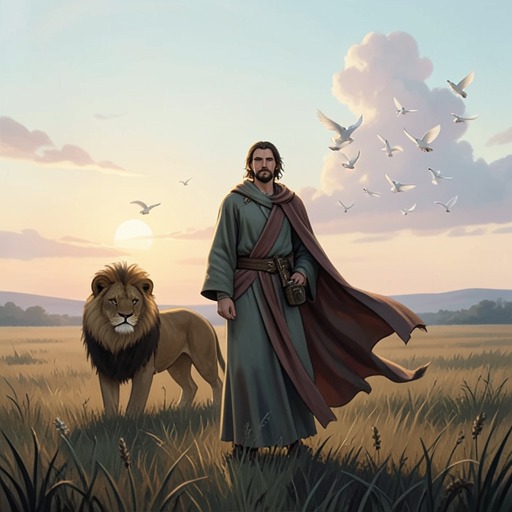
That inward struggle becomes bodily collapse when Zarathustra calls to his most abysmal thought as the advocate of Life, suffering, and the circle. He hears the abyss answer and says he has brought his ultimate depth into the light; then disgust overwhelms him. He falls like a dead man and remains so for a long time. On recovering consciousness, he is pale and trembling, will neither eat nor drink, and lies ill for seven days. Zarathustra’s Eagle and Serpent remain with him day and night, except when the eagle flies away to fetch food. The eagle lays berries, grapes, rosy apples, sweet-smelling herbs, and pinecones on the bed, and brings two lambs with difficulty from their shepherd. After seven days Zarathustra takes and smells a rosy apple, finding its scent pleasant. The small act marks a return to appetite and sensation after an ordeal precipitated by the thought he had summoned.
The Higher Men and the Final Test
Later, as Zarathustra searches for the Higher Man, he encounters The Sorcerer, who says that he seeks Zarathustra himself. After a long silence, Zarathustra directs him toward the cave and tells him that his animals can help in the search. When Zarathustra reaches the cave, he finds the Higher Men gathered there: The King on the Right and The King on the Left, The Sorcerer, The Abdicated Pope, The Voluntary Beggar, The Shadow, The Conscientious Man of the Spirit, The Prophet of the Great Weariness, The Ass, and The Ugliest Man. The Ugliest Man has crowned himself and put on two purple sashes, disguising and embellishing himself. Zarathustra’s Eagle is agitated, with its feathers ruffled, while the wise serpent hangs around its neck. The unexpected assembly reveals that the people he encountered separately have converged in his own cave.
Zarathustra recognizes the company’s gathering as the cry of distress he has heard and realizes that the Higher Man he sought is sitting in his cave. He also sees his own part in drawing them there: he has enticed them with honey offerings and the bird-calls of his happiness. Yet their presence does not make them a settled community. He warns that they are ill adapted for company and disturb one another’s hearts when they sit together. His response preserves the tension already present in his departure from his followers: he can attract and shelter others, but cannot treat their mere assembly as the achievement his teaching demands.
To the Higher Men, Zarathustra declares that the great noontide comes only after God’s death, and that the Higher Man is to become lord and master. He then gives the purpose of this transition: God has died, and now the desire is for the Superman to live. The contrast clarifies the limits of preservation as an aim. Zarathustra does not ask only how humanity can be kept in existence, but how it can be overcome. The Higher Men’s presence is therefore a beginning and a challenge, not a final fulfillment of that demand.
At a later crisis Zarathustra cries out in pity for the Higher Man, and his countenance becomes like brass. He immediately declares that this has had its time: suffering and pity are not the work he aspires to, and happiness is not his chief aim. He turns instead toward his work, announcing that the lion has come, that his children are near, that he has become ripe, and that his hour has arrived. The passage leaves him at the threshold of action rather than describing its completion. His movement from the impulse to pity toward readiness for his work gathers together the central costs of his path: solitude, longing to give, exposure to despair, and the necessity of not allowing compassion to replace the future he seeks.